

Salty Soils: How Growers Adapt to Rising Seas 101
As sea levels rise, saltwater is ruining coastal farmland. Discover the “salty” solutions farmers and Clemson University researchers are using
Salty Soils: Sea levels are rising, and farmers and researchers are finding “salty” solutions.
As global warming accelerates and the ice caps melt, National Oceanic and Atmospheric Administration (NOAA) scientists predict that sea levels along the East Coast of North America will rise a foot by 2050 [1].
Encroaching Salty Soils
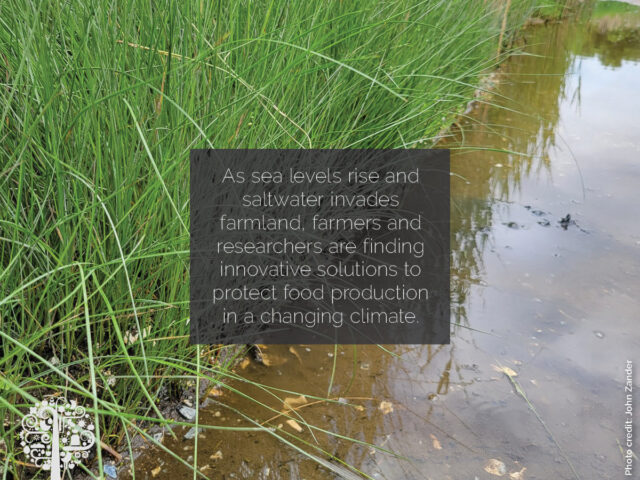
It’s already happening. In New Jersey, John Zander’s 1,300-acre family farm, Cohansey Meadows, sits on a peninsula that juts out into the saltwater of Delaware Bay [2]. Once or twice a year, a high tide or storm surge pushes ocean water deep onto the farm. It eventually recedes, but the salt from the water remains.
“The farm has been in my family since the 1990s,” Zander says. “We farm corn, soybeans, and traditional hay.”
As time progressed, Zander watched cordgrass and other perennial grasses typical of saltwater marshes encroach upon productive crop areas. He estimates that one area of approximately 25 acres has seen its perimeter shrink up to three meters.
Too much salt in the soil causes osmotic stress. It dries the roots, rendering them unable to absorb water or nutrients. Farmers like Zander are looking for solutions and coming up with inventive ideas. Combined with ongoing research projects, this paves the way for a “salty” but productive future.
Turning Salt into Hay
The salty situation at Cohansey Meadows has inspired Zander.
“The farm’s history talks about salt hay harvests as far back as the 1600s,” he explains.
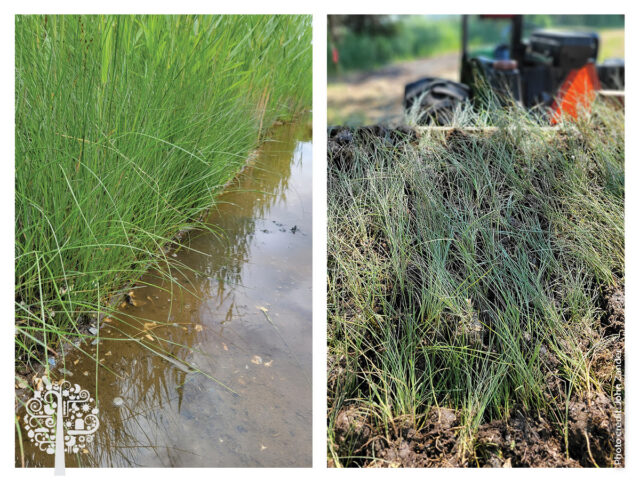
Salt hay is a colloquial term for different types of grasses growing naturally in saltwater marshes along the Atlantic Seaboard, including New Jersey’s Delaware Bay.
Historically, these grasses have been used as animal fodder, but other uses have included packing material and even mulch for berry and flower growers.
One of the drawbacks of salt hay and why it is no longer popular is its penchant for growing in marshy areas.
“You need a good freeze to get equipment into the marsh to harvest the hay,” Zander says.
Harvesting the hay by hand can be exhausting and muddy work. Thanks to a warming planet, the last hard freeze Zander remembers in the area was in 2018.
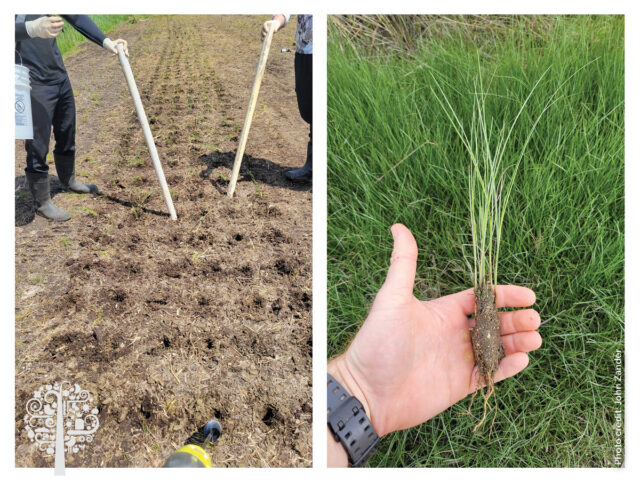
His solution has been to transplant plugs of the grasses from the wetlands on his property to higher and drier land. Growing the plugs this way makes harvesting using tractors and combines easier. As far as Zander is aware, Cohansey Meadows is the only farm in the U.S. that grows the plugs naturally in open fields as a commercial crop outside of their traditional marshy habitat.
Zander sees multiple uses for the hay. Cattle love salt, so it can be used as livestock feed. More importantly, if farmers re-seed the perimeters of fields with these coastal grasses, they can act as a buffer, blocking saltwater intrusion onto productive land. Their dense root systems suck in the seawater, which helps distil it from spreading. This border will be imperative in keeping coastal farmland productive despite the inevitable rise in sea level.
Salt and Tomatoes
Scientists worldwide are also looking for solutions to combat a salty future. At Clemson University in South Carolina, researchers believe some crops, such as mustard greens, cucumbers, and tomatoes, can also be grown sustainably in saline water. To test this hypothesis, they are experimenting with growing these edibles hydroponically [3].
“The vast majority of vegetable crops are completely interchangeable between conventional soil farming and soilless hydroponic systems, “says W. Patrick Wechter, director of the Coastal Research and Education Centre at Clemson. “Once a variety that does well in a salt-based hydroponic system is developed, it is not a huge leap to use that variety in a breeding program to fairly quickly develop a line that can be more suited to soil farming.”
They will be entirely adaptable for organic growing systems because they develop these salt-tolerant varieties through standard breeding procedures, not genetic modification.
The United Nations Food and Agriculture Organisation says that as the population increases, the world’s food supply will need to increase by 60% by 2050. But there is only enough fresh water on Earth for a 10% increase [4]. Although 71% of the Earth’s surface is covered in water, 96.5% is saltwater.
We may eventually use saline water sources such as brackish groundwater or seawater for irrigation in freshwater-scarce regions. It will matter that crops grown in these regions can tolerate the salt the water deposits into the soil.
In the future, will tomatoes and cucumbers taste salty?
“Whether the fruits or greens will become saltier is yet to be determined as there are numerous mechanisms that may be used by a plant to either take up or filter out the salt,” Wechter says.
Time will tell, but your days of reaching for extra salt might be over.
Footnotes:
- U.S. coastline to see up to a foot of sea level rise by 2050 | National Oceanic and Atmospheric Administration (noaa.gov)
- Cohansey Meadows
- Clemson awarded USDA grant to study saline-water irrigation to grow salt-tolerant crops | Clemson News
- How Much Water is There on Earth? | U.S. Geological Survey


