
he 5 Most Common Mushroom-Growing Problems
Mushroom cultivation can be a very fruitful hobby – or even business, once the correct conditions are dialled in.
Have you grown more mould than mushrooms? More flies than fungi? Is your mycelium misbehaving? Or perhaps it never started growing in the first place?
Mushroom growers get to know these problems well, and many give up after wasting lots of time and money on failed grows. Many wannabe mycologists tell me they haven’t even bothered trying for fear of contamination, insects, or other growing fails.
Worry not, mushroom lover. I’m here to help you find success in your grows!
Edible and medicinal mushroom cultivation can be a very fruitful hobby – or even business, for those who’ve done their market research. Once the correct conditions are dialled in and growers know the warning signs to look for, they can enjoy some tasty rewards.
While both beginners and pros face problems occasionally, this article will give you the best tools to avoid the common issues mushroom growers face – and tell you exactly what to do if they come your way.
This article is primarily concerned with container growing, but some advice will also apply to outdoor log-inoculation.
1. Contamination
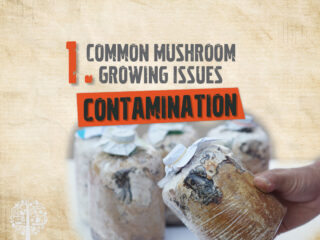
Every mushroom grower will have encountered Trichoderma mould at some point on their journey (it’s the green stuff you’ll find on that forgotten loaf of bread). A rainbow of other moulds are floating around, and bacterial contamination is common. While contaminated media often can’t be ‘fixed’, there are many ways to avoid it in the first place.
Mushrooms grow in wet and warm conditions – like mould (a type of fungi) and bacteria. Many mushroom-growing mediums are nutritious and sterile – which means an open house to any spores or bacteria that happen to be passing by. With up to 10,000 spores in every cubic metre of air, it’s unsurprising that there’s a bit of competition around.
Signs of Contamination
- Green, black, red (or pretty much any colour that isn’t white) patches on grain, substrate or mycelium. This is mould. More rarely, you will find cobweb mould that looks like a greyish cloud on the surface of a growing medium.
- Sludgy and uncolonised patches on grain or substrate. This is bacterial contamination.
- A sour and unpleasant odour.
What isn’t Contamination?
- Mushroom metabolites can look like drops of urine (that’s kind of what it is) on the surface of a substrate or spawn bag. This is a natural byproduct of the mushroom’s metabolic process and is perfectly fine.
- White cobwebby structures within a substrate are mycelium, which is commonly confused with cobweb mould (which is greyer and grows on top of a substrate).
How to Avoid
- Do mushroom ‘work’ in clean conditions
This is especially important in the early stages of mushroom growth when using sterile grain, substrates and cultures. Wash your hands, sanitise tools, and work in as clean an environment as possible. Professional growers often use HEPA air filters to do this – but you can achieve pretty good sterility inside a homemade ‘Still-Air-Box’.
Check how to make a Still-Air-Box in issue 60/58 of this magazine!
- Keep your growing space clean and well-controlled
Choose a growing area that isn’t prone to mould. Clean your growing space regularly. If you’re using a closed growing environment like a fruiting chamber, consider carbon filters for the in-flow of air.
- Use high-quality spawn and cultures
Contamination when growing indoors often stems from poorly produced grain spawn (or whatever else you’re using to make mushroom ‘seeds’). Use sterile grain from reputable suppliers if you’re buying it, or autoclave for enough time and at a high enough pressure if you’re making your own.
Similarly, it is difficult to tell if a liquid culture or spore syringe is contaminated before use. This is another thing to get from reputable vendors or make for yourself. If you use agar, it’s always a good idea to test a culture or grow some spores on a petri dish before using it on lots of expensive grain.
Growing temperatures that are too high can encourage contamination, as can overly wet substrate or grain. Check the needs of the species you are growing and try to get things just right.
What to Do if You Get Contamination
If you find contamination inside a container, you will likely need to throw away your grow, wash your equipment well, and start again. If you catch mould contamination early on, it is possible to kill off spores by spraying the area with a 3% hydrogen peroxide solution. I have had limited success with this approach.
If you have other growing containers, it is essential to isolate any contaminated substrates as soon as you catch them so they do not spread. Do not open contaminated containers inside your growing environment!
2. Slow Colonization or ‘Stalled’ Grows
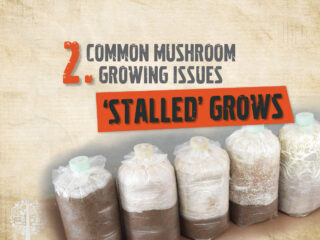
The second most regular cause of heartbreak for hopeful growers. They’ve bought all the right equipment, followed their instructions and built a Breaking Bad-level laboratory to avoid contamination. Then, the weeks go by, and very little happens. Perhaps they see a little mycelium growing, or none at all. Some see a positive start, and then everything… stops. This can be devastating after all the effort of getting a grow on.
How to Avoid
- Colonize in optimal and consistent temperatures
Mushrooms have specific environmental requirements to grow well, including temperature, humidity, light, and airflow. At the colonisation stage, temperature is often the variable people don’t get right. Many growers with ‘stalling’ issues have containers in areas with too low or fluctuating temperatures, which can inhibit growth and stress the mycelium, destroying a potentially beautiful crop of mushrooms.
If you live in colder areas, an inexpensive greenhouse heater and temperature controller (I use an ‘Inkbird’) is likely to up your growing game and minimise ‘stalling’. Check the optimum growing temperature for the species you are cultivating and just dial it in.
A word of warning about lizard heat mats, which many use directly under mushroom-growing containers: these can burn or dry out the areas they touch. A good rule is to heat your growing space, not the container itself, so I am a fan of the greenhouse heater approach. If you intend to use a heat mat, put spacers between it and your growing containers.
- Keep colonising spawn and substrates in ‘underground’ conditions
Avoid bringing your colonising containers into the light more than you need to. This is difficult when you want to compulsively check on your mycelium babies (I’ve been there), but it can confuse the fungus about its growth stage. Keep containers closed to avoid changes in climate, and check through the sides of the container every five days or so before returning it to its underground home.
Make sure your mycelium has access to a small amount of air. This can be through the cracks in a tub or filter patches on a mushroom-growing bag. Mycelium must breathe a small amount – even when ‘underground’ – or it will suffocate.
What to Do if You Get Slow or Stalled Grows
Do your research about the specific species you are growing and dial in the optimal conditions for them ASAP. Then sit back and cross your fingers that you’re not too late.
If you notice sludgy, uncolonized patches forming on your grain or substrate, this is likely to be bacterial contamination. This happens regularly when things have been sitting uncolonised for some time. Remove the container from your growing space, bin the contents, pray to the mushroom gods and get ready to start again.
3. Low (or No) Mushroom Yields
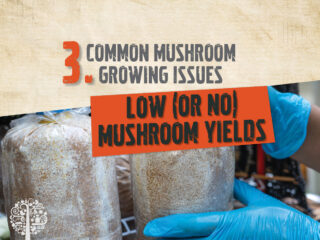
You’ve avoided contamination and nurtured your vibrant white block of mycelium into the world. Now it’s time to birth it and harvest the many fruits, right?
For some, the promised mushrooms just don’t start growing at this stage, and others get much less than expected.
How to Avoid
- Simulate consistent fruiting conditions
Most mushrooms need high humidity and fresh air exchange to grow well at the fruiting stage. You can achieve this by wafting the substrate regularly with a book and spraying the inside of your container with a water mister. Optimising light and humidity (using automated fogger units and daylight-level LEDs) is optional but will give you more consistency in your grows.
- Check the right fruiting conditions for the species of mushroom you are growing
Some mushrooms need slightly different air exchange or humidity to grow well. Certain species need more time than others to start fruiting. Some also need a ‘casing layer’ (usually vermiculite) on top of the substrate to fruit well.
Individual species have their quirks, so it’s worth doing your research. For example, king oyster mushroom mycelium can benefit from a night in the fridge to trigger mushroom growth, while some shiitake growers drop their blocks to simulate a tree falling in the forest and stimulate fruiting!
- Choose the right substrate
Use a substrate that matches your mushroom species. For example, hardwood sawdust is ideal for shiitake, while straw works well for oyster mushrooms. Add supplements like bran or gypsum to boost nutrients, but be cautious, as over-supplementation can lead to contamination.
Ensure the substrate has the right water content, often called “field capacity.” Squeeze the substrate; if only a few drops of water come out, it has a good moisture level.
4. Poor-quality mushrooms
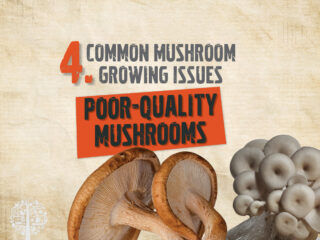
Perhaps yourmushrooms don’t look right – squishy, malformed, furry or too long. Often, this doesn’t mean they’re inedible (although I would ditch the squishy ones as these likely died a while ago). Still, it’s satisfying to grow something beautiful.
Low-potency crops are a more pressing issue for many growers. This can be due to genetics, but often, it is due to improper processing after harvest.
How to avoid
- Ensure correct fruiting conditions
Furry-bottomed mushrooms often lack consistent airflow. Similarly, ‘leggy’ oyster mushrooms crave more fresh air exchange. Lots of ‘aborts’ (small, squishy, dead mushrooms) are sometimes a sign of stagnant moisture on the mushrooms, which could also be due to poor air exchange.
‘Mutant’ or other low-quality mushrooms can be caused by bad genetics. Get your mushroom cultures from a reputable supplier. Try to get liquid cultures if you can, as strong genetics will (hopefully) have already been selected. Spore syringes can give more random results.
- Harvest and process mushrooms well
The best moment to pick many mushrooms is when the ‘veil’ breaks between the stem and the cap. With oyster mushrooms, it is when the cap opens but before it goes concave. Check out the best time to harvest the variety you are growing.
Consuming or processing mushrooms as soon as possible after harvest is essential to retain potency. For long-term storage, I recommend dehydrating at 70°C until cracker-dry, then storing them in an airtight container with silica gel sachets as an extra precaution. Keep them in the dark—or store your dried mushrooms in the freezer if you’re keen.
5. Fungus Gnats
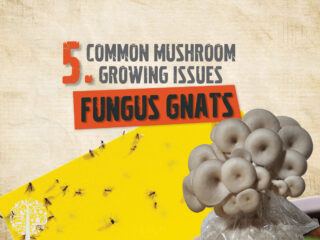
Many mushroom growers will be too familiar with the ‘fungus gnat’ – a fly that loves mushroom substrate and other wet soil. Once they get into a growing environment, they multiply very quickly, and their tiny, winged bodies can travel easily between growing containers and house plants. I have had a few full-on infestations in my home, and I’m not going to sugar-coat it – it’s pretty disgusting.
The upside is that fungus gnats don’t seem very interested in mushrooms themselves, so if you can bear them or keep them at bay until harvest day, you’ll still get some food for your dinner.
How to Avoid
- Keep your growing space clean
Bits of nutritious debris can attract fungus gnats and other flies. Minimise these as much as possible. If growing at home, keep your living space as clean as possible, especially during warmer months.
A separate grow room or contained space like a fruiting chamber can give you some control over what goes in, especially if you use air filters.
Sticky fly traps can work as a preventative measure – and to reduce populations if you start getting an infestation.
What to Do if You Get an Infestation
Take infested containers out of your grow room and consider sealing off cracks in other containers so rogue gnats can’t get in and lay their eggs.
One trick that works well for house plants (and reportedly for some mushroom containers, too) is introducing scariad nematodes. You can add the eggs of these microscopic worms into the water and soak the growing medium in it. Over a few weeks, this can kill off the flies and their eggs – if you can hang on for that long.
You can check out Alex’s latest online course, ‘Growing Mushrooms on Pre-Cooked Rice’ here.


