
NCC: Land Lines – NCC shares expertise at the Canadian Ecological Connectivity Conference

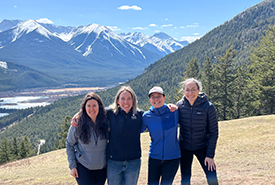
NCC staff members Katelyn Ceh, Aerin Jacob, Emilie Brien and Marie-Andrée on connectivity field trip in Banff National Park, AB. (Photo courtesy of Aerin Jacob/NCC staff)
This April, researchers from the Nature Conservancy of Canada (NCC) were invited to contribute to Canada’s first-ever Canadian Ecological Connectivity Conference, held Banff, Alberta. The event brought together a wide range of voices including people from non-profit organizations, governments, businesses, communities and universities as well as landowners and Indigenous representatives — all committed to strengthening ecological connectivity across landscapes.
Sharing Quebec’s success stories
Marie-Andrée Tougas-Tellier, project manager for NCC in Quebec, presented insights from the Quebec Ecological Corridors Initiative (QECI). Her presentation highlighted both the challenges and successes emerging from this innovative program, illustrating how strategic corridor planning can make a real difference for wildlife movement and ecosystem health across southern Quebec.
The power of private land conservation

NCC’s director of science and research, Aerin Jacob, giving a talk about private land conservation. (Photo by Tess McEnroe, Y2Y)
NCC’s director of science and research, Aerin Jacob, presented on the important roles that privately protected areas play in connectivity conservation, showcasing how NCC’s work fits into the broader landscape of ecological connectivity. Emphasizing the importance of working at multiple scales — considering the linkages among local, regional, national and even international conservation — she showed ecological connectivity is woven into NCC’s conservation direction of creating more resilient landscapes. This included sharing scientific highlights from past and present research, and what results mean for public and private land conservation.
Where we go from here
The conference culminated with Aerin delivering a powerful closing plenary address. Drawing on her scientific expertise and storytelling skills, Aerin reflected on four themes in the week’s discussions — persistence, evidence, communication, and collaboration — and outlined the needs and opportunities ahead for connectivity conservation in Canada. She emphasized the catalytic power of Parks Canada’s National Program for Ecological Corridors and the need to keep our conservation ambitions high. “Free yourself with courage — courage to take a chance on new ideas and partnerships, to say and do the difficult things that need to be said and done, and to build on what we’ve learned and shared here,” she said.
Why connectivity matters
Ecological connectivity sits at the heart of landscape resiliency — it’s the “C” in NCC’s CARE framework. When ecosystems are well connected, they’re better equipped to adapt to environmental changes and support thriving wildlife populations. This principle drives much of NCC’s conservation work across the country.
Looking ahead
Canada’s first ecological connectivity conference has set the stage for enhanced collaboration and innovation in conservation from local to continental scales. For NCC, it was an opportunity to share how we approach our work and learn about the incredible connectivity conservation happening across the country. The connections made and insights gained will undoubtedly strengthen our efforts to protect and connect the natural spaces that matter most.
As we continue working toward a future where wildlife can move freely across resilient, connected landscapes, events like this remind us that we’re not working alone — we’re part of a growing movement dedicated to ensuring nature and people thrive.
About the Author
NCC staff Since 1962, the Nature Conservancy of Canada (NCC) has protected areas of natural diversity for their intrinsic value and for the benefit of our children and those after them. To this day, NCC continues to protect land and share stories of nature, wildlife, science and conservation.


